

On this page
This page records Google's major, named search algorithm updates since 2011: what each one targeted, when it rolled out, and how it changed ranking behavior. It is maintained as a reference rather than a narrative, and it is updated each time Google confirms a new major update. A changelog at the bottom logs each addition. For the parallel story of generative AI's effect on search, see the AI search history guide.
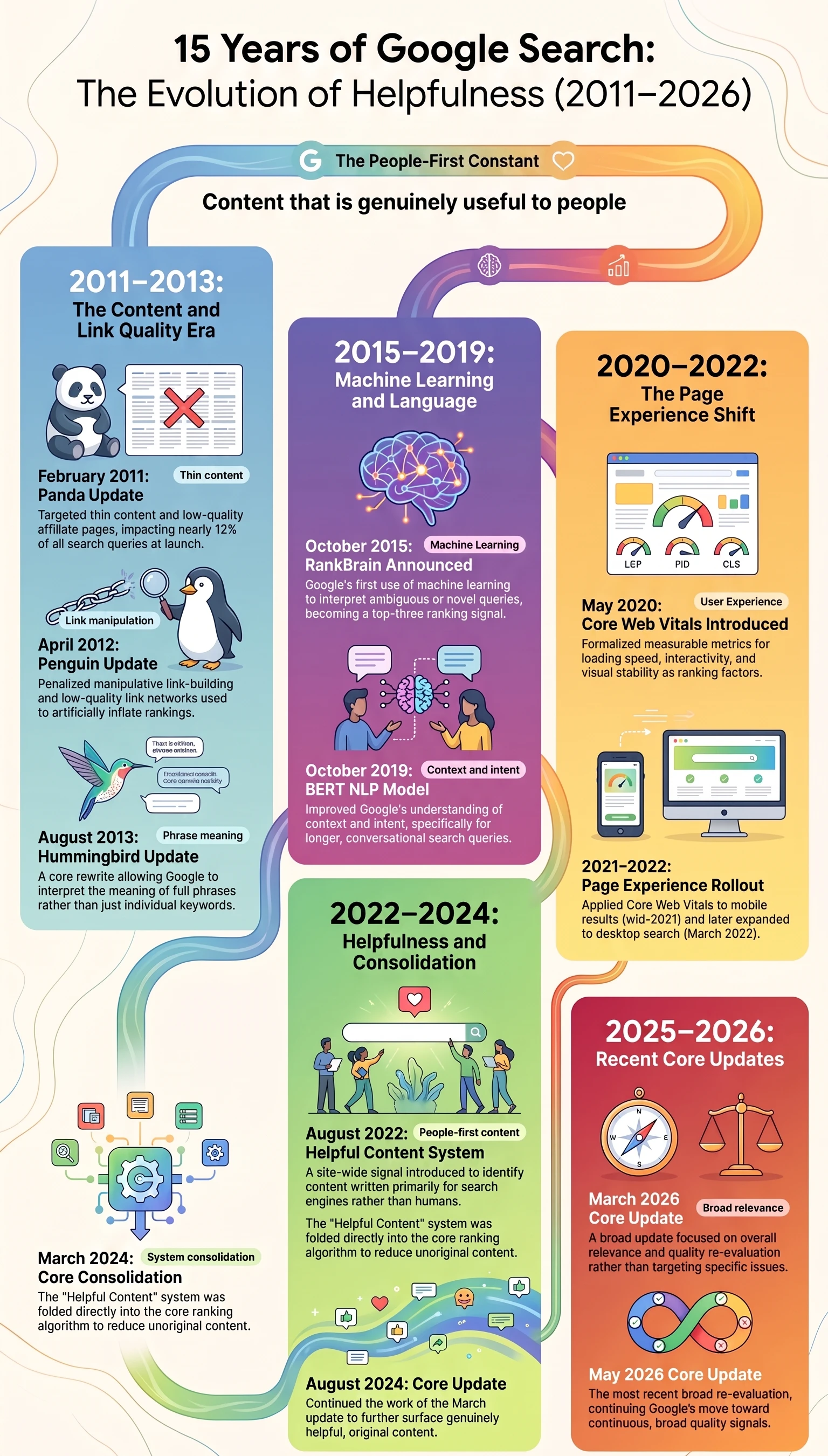
2011-2013: content and link quality
Panda (February 2011). Targeted low-quality and thin content, including pages built primarily for affiliate links or advertising rather than substantive information. Panda noticeably affected rankings on an estimated 11.8% of search queries at launch, one of the largest measured impacts of any update to that point. It was folded into Google's core ranking algorithm in January 2016 and has run continuously since.
Penguin (April 24, 2012). Targeted manipulative link-building, including paid links and low-quality link networks built specifically to inflate rankings. Like Panda, Penguin was absorbed into the core algorithm in 2016, meaning it now runs as a continuous signal rather than a periodic update.
Hummingbird (August 2013). A rewrite of Google's core query-processing system, built to interpret the meaning of a full search phrase rather than matching individual keywords. Described at the time as the biggest change to Google's algorithm in three years. Hummingbird is the clearest early precursor to the natural-language understanding that later updates (RankBrain, BERT) would extend.
2015-2019: machine learning and language understanding
RankBrain (announced October 26, 2015). Google's first publicly confirmed use of machine learning as a core ranking signal, used to interpret ambiguous or novel queries Google hadn't encountered before. Google stated at the time that RankBrain was the third-most important ranking signal, behind content and links.
BERT (announced October 25, 2019). A natural-language-processing model applied to search, improving Google's ability to understand context and intent in longer, conversational queries. Rollout for English-language queries, including featured snippets, began the week of October 21, 2019, later expanding to more languages.
2020-2022: page experience becomes a ranking factor
Core Web Vitals introduced (May 28, 2020). Google announced a specific set of measurable page-experience metrics, loading speed, interactivity, and visual stability, that would factor into ranking. This was the first time Google formalized page-experience measurement into named, quantifiable metrics rather than a general "site speed" consideration.
Page Experience Update, mobile (June-August 2021). The first ranking update to apply Core Web Vitals directly, rolling out gradually to mobile search from June through the end of August 2021.
Page Experience Update, desktop (March 2022). Extended the same page-experience signals to desktop search results.
2022-2024: helpfulness and consolidation
Helpful Content Update, first (August 25 - September 9, 2022). Introduced a new system specifically to identify content written primarily to rank in search rather than to genuinely help a reader, applying a site-wide signal rather than judging pages in isolation.
September 2022 Core Update (September 12-26, 2022).
Helpful Content Update, second (December 5, 2022 - January 12, 2023).
March 2023 Core Update (March 15-28, 2023).
Helpful Content Update, third (September 14-28, 2023).
November 2023 Core Update (began November 2, 2023).
March 2024 Core Update (March 5 - April 19, 2024). A significant consolidation: this update folded the previously separate helpful content system directly into the core ranking algorithm, rather than running it as a distinct overlay. Google described the goal as reducing low-quality, unoriginal content in search results overall.
August 2024 Core Update (began August 15, 2024). Positioned by Google as a continuation of the March 2024 work, aimed at further surfacing genuinely helpful content.
2025-2026: recent core updates
December 2025 Core Update (December 11-29, 2025). The final broad core update of 2025.
February 2026 Discover Update (February 5-27, 2026). The first update Google announced specifically for Discover rather than Search results, limited at launch to English-language content in the United States.
March 2026 Core Update (March 27 - April 8, 2026). A broad core update; Google's core updates by this point were routinely described only in general terms (overall relevance and quality improvements) rather than targeting one specific content issue. Google said it could take up to two weeks and it completed in twelve days.
May 2026 Core Update (May 21 - June 2, 2026). The most recent broad core update as of this writing, completing in just under twelve days.
Broad core updates like those above differ from the earlier named updates (Panda, Penguin, Hummingbird) in that Google no longer describes them as targeting one specific problem. Since roughly 2023, Google's official guidance has been that core updates are broad relevance and quality re-evaluations, and that there is no single fix for a site affected by one beyond the general advice in Google's own quality rater guidelines.
Spam updates run on a separate track
Google announces spam updates separately from core updates. They target sites violating Google's search spam policies rather than re-evaluating quality across the index, and they typically roll out in days rather than weeks.
March 2026 spam update (March 24-25, 2026). Applied globally and to all languages. It completed in roughly nineteen and a half hours, unusually fast for an announced update.
June 2026 spam update (June 24-26, 2026). Also global and applied to all languages, described by Google in the same standard terms as the March update. It took two days to finish.
August 2026 spam update (August 18-21, 2026). The third spam update of 2026, again applied globally and to all languages. It took roughly two and a half days to complete, and, as with the March and June updates, Google did not announce any new spam policies alongside it.
September 2026 spam update (began September 24, 2026). The fourth spam update of the year, applied globally and to all languages. Google gave each of the year's first three spam updates a rollout window of "a few days"; for this one, Google said the rollout could take up to two weeks, and as of this writing the Search Status Dashboard had not yet logged a completion time. Google did not identify a specific spam policy or tactic as the update's focus.
As of October 1, 2026, the September 2026 spam update is the most recent ranking update Google has confirmed on its Search Status Dashboard.
Smaller core updates that are never announced
On December 9, 2025, Google added a section to its official core update documentation confirming something Danny Sullivan had said informally as far back as 2019: Google continually makes smaller core updates that it does not announce, because they are not widely noticeable. Google's stated reason for documenting it was to clarify that a site owner who improves their content can see a ranking gain without waiting for the next announced core update. In practice this means ranking movement outside an announced update window is expected behavior rather than evidence of an unlogged major event.
What this means in practice
The throughline across fifteen years of updates is consistent even as the specific mechanisms changed: Google has moved steadily toward evaluating whether content is genuinely useful to the person who searched for it, and away from ranking factors that could be gamed through keyword repetition, link manipulation, or formulaic content production. Machine learning (RankBrain, BERT) improved Google's ability to detect intent and meaning; the helpful content system and its later absorption into the core algorithm shifted enforcement from a narrow spam filter to a broad, continuous quality evaluation. Building a page that clearly and specifically serves a real reader's need has remained the one constant piece of advice that has survived every update on this list.
Changelog
October 1, 2026 — Added the September 2026 spam update (began September 24, 2026), the fourth spam update of the year, per Google's Search Status Dashboard and Search Engine Journal's reporting. The rollout was still in progress as of this writing, with a Google-stated window of up to two weeks, longer than any of 2026's three earlier spam updates. Checked for a September 2026 core update; several SEO-industry sites reported one (roughly September 12-26), but it is not listed on Google's own Search Status Dashboard, so none was added here.
September 1, 2026 — Added the August 2026 spam update (August 18-21, 2026), per Google's Search Status Dashboard. Checked for an August 2026 core update; none was confirmed on the Status Dashboard as of this writing despite ranking-volatility reports from third-party trackers in early August, so none was added.
July 28, 2026 — Added the December 2025 core update, the February 2026 Discover update, the March 2026 and June 2026 spam updates, and corrected the March 2026 and May 2026 core update end dates, all per the Google Search Status Dashboard. Added a section on the December 9, 2025 Search Central documentation change confirming unannounced smaller core updates.
July 28, 2026 — Page published, covering Panda (2011) through the May 2026 core update.
More Resources
AI Search History: How LLMs Reshaped Organic Traffic (Living Guide)
A living reference on how large language models changed Google search, from schema.org in 2011 to 2026's AI Overviews and Search Console AI reports.
ResourcePhilippine Digital Compliance Guide for Business Websites
What Philippine law actually requires of a business website: data privacy, e-commerce disclosure, and business registration, in plain language.
ResourceDigital Marketing & SEO Glossary | Audrim Resources
Plain, precise definitions of the SEO, web design, and digital marketing terms Philippine business owners run into most. Updated as terminology changes.