

Part of how ADMS finds new clients is looking at real business websites before we ever reach out, mostly around Cebu but increasingly in the tourism towns around it too. After going through dozens of them this year, a pattern shows up often enough that it's worth naming directly: some of these sites aren't just failing to help. They're actively costing their owners customers, and the owner usually has no idea.
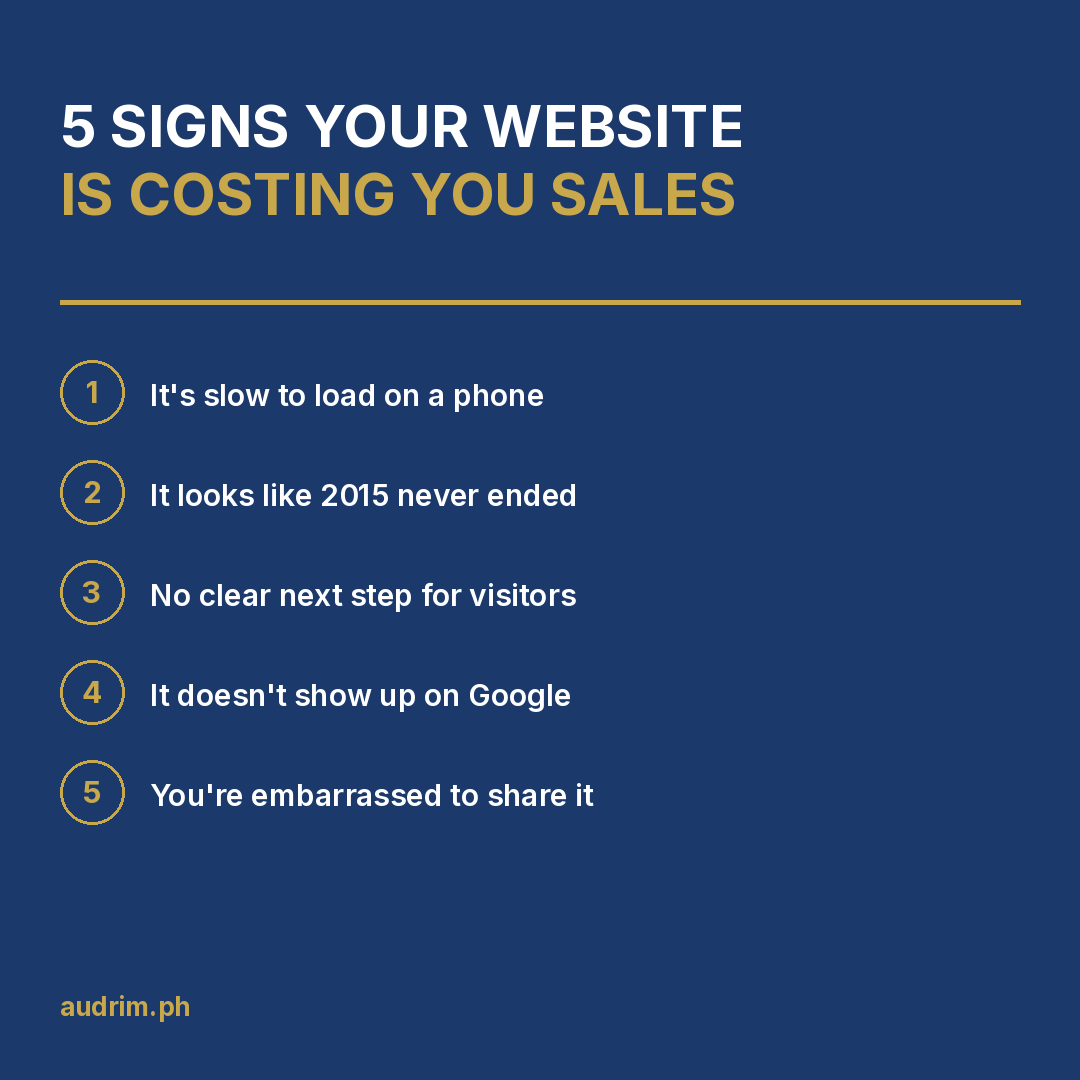
Here are the five signs we see most, and what they're actually costing you.
It takes too long to load on a phone
Almost everyone who finds a Philippine business online today does it on a phone, often on a mobile connection that isn't fast by global standards. A 2016 Google study of over 900,000 mobile ad landing pages found that as load time went from one second to five, the probability of a visitor bouncing before the page even finished loading rose to 90%. That number is nearly a decade old now, but the underlying problem hasn't gone away. If anything, it's more relevant here: national mobile speed averages in the Philippines still sit in the lower half of global rankings, so a site built and tested on someone's fast office wifi can behave very differently on the connection most of your actual customers are using.
We've opened resort and dive shop sites, whether based in Moalboal or aspiring toward Palawan-level tourist traffic, that take eight or nine seconds to show a single hero photo. Every one of those seconds is a visitor who never saw the booking form.
It looks like it hasn't been touched since it launched
Design is a trust signal before it's anything else. A site built five or six years ago and never updated since tells a visitor something, whether or not that's the intended message: this business might not be paying attention anymore. We've seen this most often on sites for businesses that are, in reality, doing fine, a well-reviewed clinic, a genuinely good restaurant, but whose website undersells them so badly that a new visitor has no way to know that from the site alone.
A visitor can't tell what to do next
This is the one we flag most often in early audits, because it's invisible to the business owner and obvious to everyone else. Open your own homepage and give yourself five seconds. Is it immediately clear what you do, who it's for, and how to reach you? On a lot of the sites we've reviewed, the honest answer is no. There's a logo, a stock photo, maybe a mission statement, and nothing that tells a visitor what to actually do next. A phone number that's clickable, a booking button, a contact form above the fold: small things, and the sites without them are consistently the ones with the lowest inquiry volume relative to their traffic.
It doesn't show up when someone searches for it
A site that exists but doesn't appear in Google is close to not existing at all for anyone who didn't already have the link. We cover the mechanics of why in the guide to local search and Google Business Profile, but the quick version is: if searching your own business category plus your city brings up your competitors and not you, that's fixable, and it's usually not a small technical mystery. It's a handful of specific, known gaps.
The owner doesn't want to share it
This last one isn't technical, but it's the most honest signal there is. When a business owner hesitates before giving out their own website, or qualifies it with "it's a bit old, but," that instinct is almost always correct, and it's the same instinct a visitor has when they land on the page. We've had this exact conversation with more than one prospective client. If you wouldn't confidently hand your site to someone whose opinion you care about, that's worth taking seriously.
None of this requires an expensive rebuild to fix. It requires knowing which of these five is actually the problem on your specific site, which is different for almost every business we've looked at. If you're not sure which one applies to yours, that's a conversation worth having before you spend anything on ads driving traffic to a site that's working against you.